The joy of receiving the keys to your newly renovated home often vanishes the moment you wipe your hand across a brand-new cabinet.
In 2026, popular interior design trends like raw cement screed, hacked open-concept kitchens, and custom carpentry generate massive amounts of fine, white silica dust. This microscopic dust doesn’t just sit on the floor; it floats through the air, coats the inside of your newly built wardrobes, clogs the tracks of your sliding windows, and settles deep inside your air-conditioning units.
Moving in without properly eliminating this hazard can trigger severe respiratory issues, especially for young children and asthma sufferers. Standard household vacuums will simply blow this fine dust back into the air—or worse, the motor will burn out entirely.
Use our 2026 Post-Renovation Dust Estimator below to calculate exactly how many professional man-hours are required to make your new home safe, breathable, and move-in ready.
2026 Post-Reno Dust Calculator
Estimate the required cleaning intensity for a safe move-in.
Standard Clean vs. Post-Renovation Deep Clean
| Area / Action | Standard Housekeeping | Post-Renovation Clean |
|---|---|---|
| Vacuuming Equipment | Standard household vacuum (e.g., Dyson). | Heavy-duty wet/dry Industrial HEPA Vacuum. |
| Cabinetry & Wardrobes | Exterior wipe-down only. | Interior detailing, hinge wiping, and drawer track vacuuming. |
| Walls & Ceilings | Generally ignored unless visibly stained. | High-dusting of ceilings, light fixtures, and dry-wiping walls to remove silica static. |
| Floors | Standard mopping (1 pass). | Multiple passes to remove "chalky" residue, cement stains, and paint drips. |
Cleaning up after a contractor is arguably the most difficult type of residential cleaning. In 2026, many homeowners try to save money by doing the post-renovation clean themselves, only to spend three exhausting days mopping the same floor because a persistent, chalky white residue keeps reappearing when the water dries.
Why Household Vacuums Fail
Do not use your expensive Dyson or standard household vacuum to clean up construction dust. The particles of silica dust, cement powder, and drywall are microscopic. They easily bypass standard consumer-grade filters and are sucked directly into the vacuum's motor. This causes the motor to overheat and permanently burn out, turning a cleaning chore into a $800 appliance replacement.
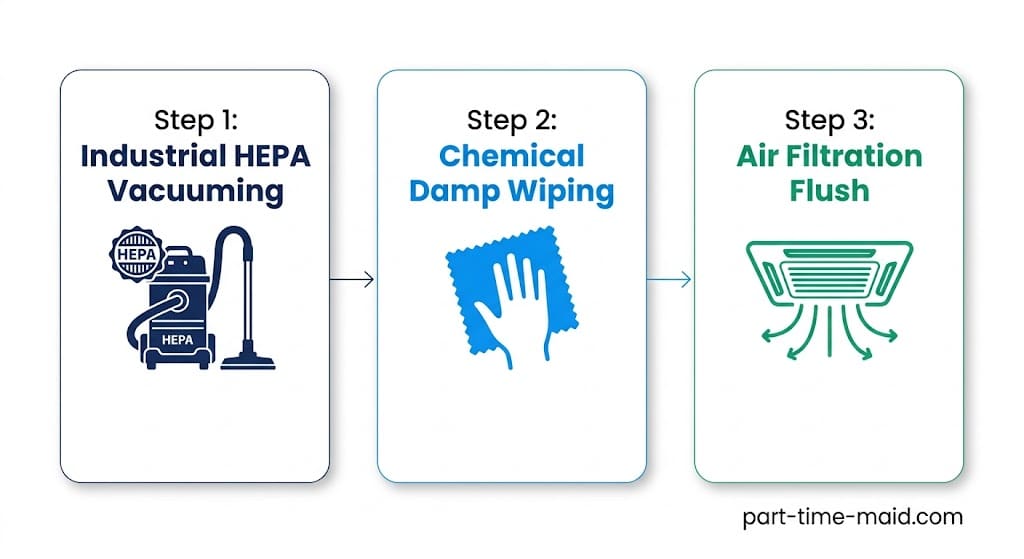
Professional teams use industrial-grade wet/dry vacuums fitted with True HEPA filters specifically designed to safely capture and trap construction dust.
The "Static" Dust Phenomenon
One of the most frustrating aspects of post-renovation dust is its static charge. It clings vertically to walls, glass windows, and inside the hinges of brand-new kitchen cabinets. If you try to wipe this dust with a very wet cloth, you essentially create wet cement, which smears and stains the surfaces.
Professionals use a systematic approach:
- Dry Extraction: Using industrial vacuums with brush attachments to gently pull the static dust off surfaces.
- Microfiber Trapping: Using slightly damp, high-quality microfiber cloths to trap the remaining particles without turning them into mud.
- Chemical Residue Removal: Using specific floor solutions to break down the alkaline "chalkiness" left on new tiles and vinyl flooring.
The Importance of Team Coordination
A proper post-reno clean cannot be done by a single person in a few hours. It requires coordination. While one cleaner is high-dusting the ceiling fans and aircon ledges, another is detailing the tracks of the sliding glass doors, and a third is scrubbing the protective film residue off new toilet bowls.
By booking an experienced, multi-person team from Part-Time-Maid.com, you ensure your home is transformed from a hazardous construction zone into a safe, breathable sanctuary in just one day.
Post-Renovation Cleaning FAQs
Will the cleaners dispose of leftover construction materials? +
When exactly should I schedule the cleaning? +
Do I need to hire chemical washing for my floors? +
Move Into a Safe Home.
Don't let fine construction dust trigger allergies or ruin your new appliances. Let our specialized post-reno teams handle the heavy lifting.
Industrial Vacuums and Ladders Included.